Say a customer who has missed two payments rings on Monday and mentions they've just lost their job. The agent offers one option. On Thursday the same customer rings again, a different agent picks up, and the offer is different. Both agents may have done what they thought was right, and the customer has still heard two answers.
The first thing to check on forbearance and vulnerability is whether the same customer, ringing twice, hears the same options. You can test that with a handful of calls, and the FCA's findings give you a reason to look at the record behind each call as well as the call itself.
The first thing to check on forbearance and vulnerability is whether the same customer, ringing twice, hears the same options. You can test that with a handful of calls, and the FCA's findings give you a reason to look at the record behind each call as well as the call itself.
Only 4 in 10 people with characteristics of vulnerability have told their provider
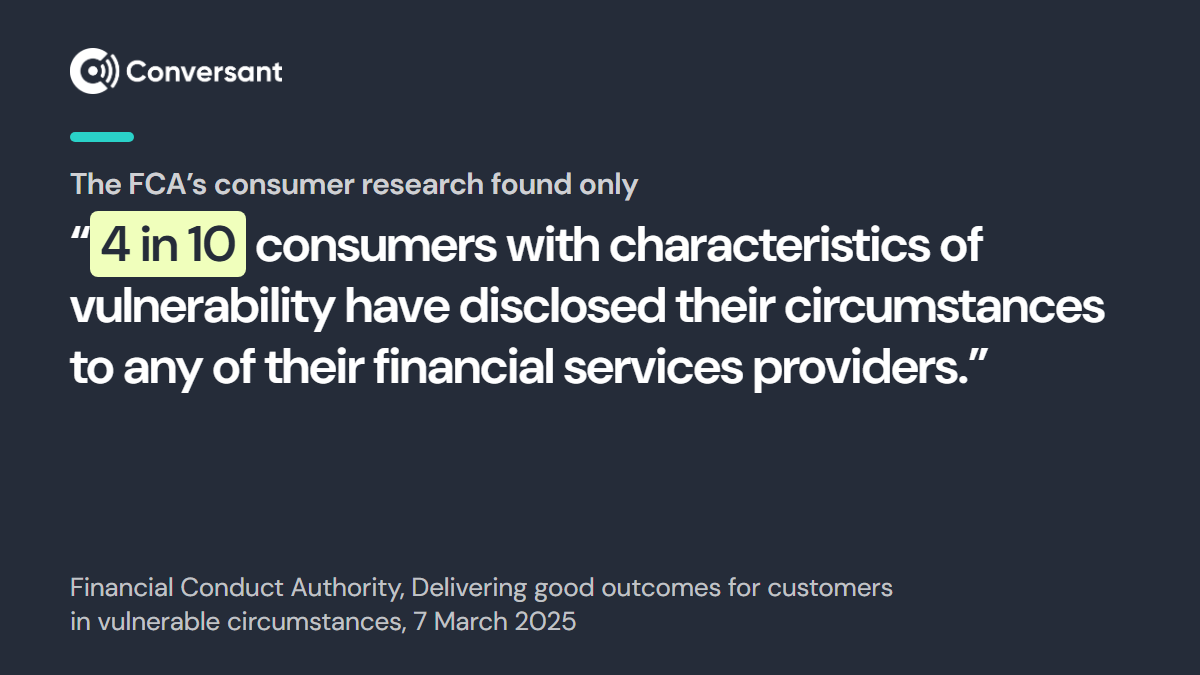
In its March 2025 review of customers in vulnerable circumstances, the FCA reported on its own consumer research. It found that only "4 in 10 consumers with characteristics of vulnerability have disclosed their circumstances to any of their financial services providers."
A circumstance said out loud on a call is something your firm has to catch the first time. Say a customer mentions a job loss in passing, between a question about the payment date and a question about the balance. The agent can hear it and the record can still end up without it.
When someone does say it, the next question is what happens to it.
When someone does say it, the next question is what happens to it.
Where does a circumstance go after the call?
The same review looked at power of attorney and bereavement journeys at retail banks and building societies. In that work, the FCA wrote that "call handlers in some firms were not using their firm's systems to check the information recorded on a customer's circumstances or needs." It went on, "In some cases, this meant appropriate support was not provided, putting customers at risk of receiving poor outcomes."
That finding covers those two journeys and names no firm, so it says nothing about arrears calls. The question carries over, though. When an agent takes a call from a customer in financial difficulty, can they see what was recorded last time, and do they look?
That finding covers those two journeys and names no firm, so it says nothing about arrears calls. The question carries over, though. When an agent takes a call from a customer in financial difficulty, can they see what was recorded last time, and do they look?
Good practice meant saying it once
Among the good practice the FCA described was "Using centralised systems to store information about a customer's circumstances or needs". It added, "This meant customers did not have to repeat potentially sensitive information."
For a lender or a building society, that gives you a plain test. Could a second agent see what the customer said on Monday, without asking them to say it again on Thursday?
For a lender or a building society, that gives you a plain test. Could a second agent see what the customer said on Monday, without asking them to say it again on Thursday?
Run the same situation twice
Here is a way to test it that takes an afternoon. It is our suggestion, and three calls is a place to start.
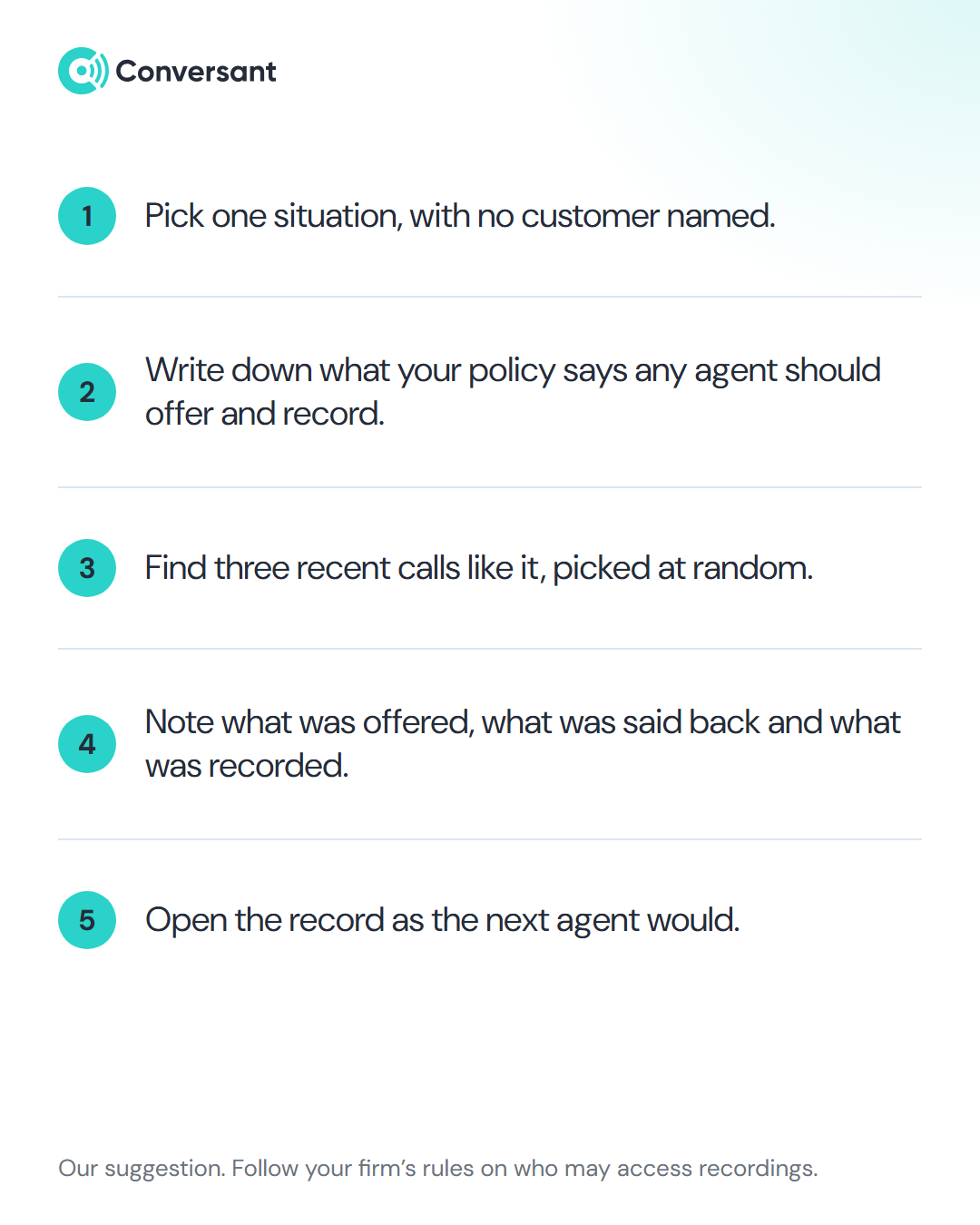
1. Pick one situation, described in plain words with no customer named, such as a customer who has missed two payments and says they have lost their job.
2. Write down what your policy says any agent should offer and record for that situation, and who decides when there is discretion.
3. Find three recent calls where a customer described something like it, picked at random.
4. For each call, write down what was offered, what was said back and whether the circumstance was recorded.
5. Open the customer's record as the next agent would. Can you see what they said, without asking them to say it again?
1. Pick one situation, described in plain words with no customer named, such as a customer who has missed two payments and says they have lost their job.
2. Write down what your policy says any agent should offer and record for that situation, and who decides when there is discretion.
3. Find three recent calls where a customer described something like it, picked at random.
4. For each call, write down what was offered, what was said back and whether the circumstance was recorded.
5. Open the customer's record as the next agent would. Can you see what they said, without asking them to say it again?
Discretion can explain a difference when the reason is on the record. Where nobody wrote one down, that's the gap to close.
Three things are worth listening for on each call. Did the agent ask about the customer's situation, or wait to be told? Do the options they gave match what your policy says for that situation? And what did they type into the record before the call ended? Put the answers for all three calls side by side, and any difference stands out.
Listen to calls under your firm's normal rules for who may access recordings and personal data, and keep your notes free of names.
Three things are worth listening for on each call. Did the agent ask about the customer's situation, or wait to be told? Do the options they gave match what your policy says for that situation? And what did they type into the record before the call ended? Put the answers for all three calls side by side, and any difference stands out.
Listen to calls under your firm's normal rules for who may access recordings and personal data, and keep your notes free of names.
What the FCA's findings leave to you
The FCA's findings come from its work on customers in vulnerable circumstances, including its power of attorney and bereavement journeys. They don't tell you what your own arrears and forbearance policy has to offer, and we take no view on what any rule requires of your firm. Your compliance team owns that question.
What the findings give you is a prompt to check the record behind the call. If three calls turn up three different offers, you'll want to know why before anyone else asks.
We help firms spot the signs of vulnerability in customer calls, so the team can pick it up early. We're happy to talk it through.
What the findings give you is a prompt to check the record behind the call. If three calls turn up three different offers, you'll want to know why before anyone else asks.
We help firms spot the signs of vulnerability in customer calls, so the team can pick it up early. We're happy to talk it through.