Say your quarterly board pack shows complaints down and quality scores up, and a director asks what that tells you about how people were treated on the phone. If the pack holds only the counts, the question stays open. The FCA made the same point about outcomes monitoring in July 2026, and the first thing to do about it is something you can finish this month: write the chain from each number to a decision, an action and a result, then read some of the conversations behind it.
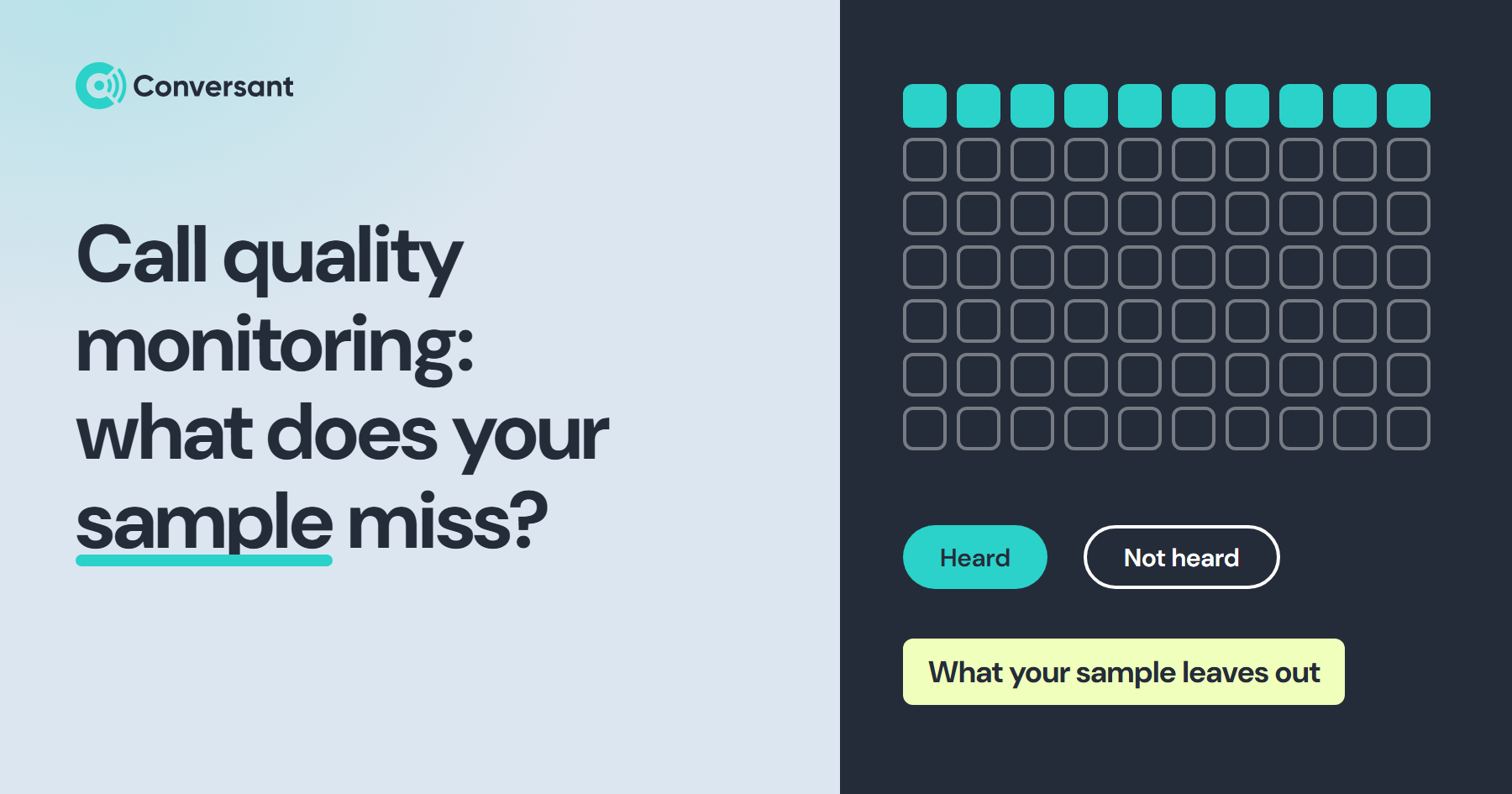
Management information counts what your systems record. What was said on the call, and whether it left the customer better served, sits outside the count.
Management information counts what your systems record. What was said on the call, and whether it left the customer better served, sits outside the count.
The FCA says management information alone does not show outcomes
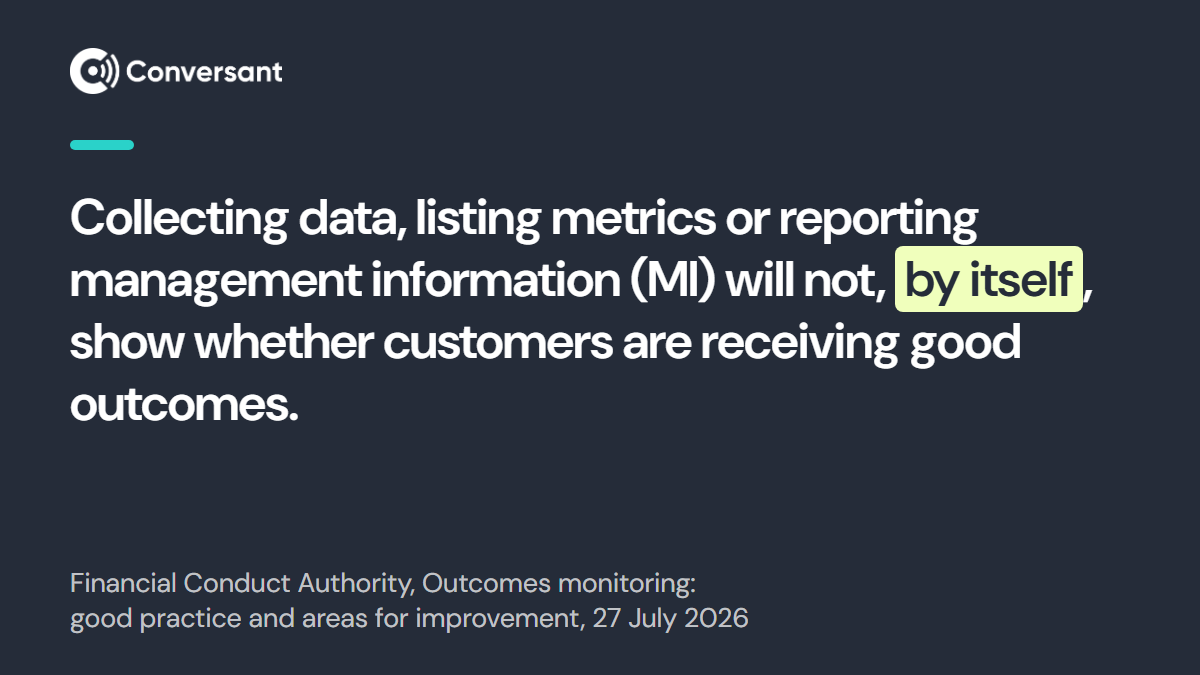
In July 2026 the FCA published its review of outcomes monitoring, which surveyed 56 firms on their strategy, their use of data and MI, and their governance. The introduction makes this point: "Collecting data, listing metrics or reporting management information (MI) will not, by itself, show whether customers are receiving good outcomes."
The FCA reviewed firms of a range of sizes, and for smaller firms it says what matters is being able to explain what their information shows and how it helps them spot harm or poor outcomes. That leaves room for a proportionate answer and none for an empty one. MI still has a job, which is to tell you where to look, and the rest of this piece is about what to do once it has.
Four things your outcomes monitoring has to help you explain
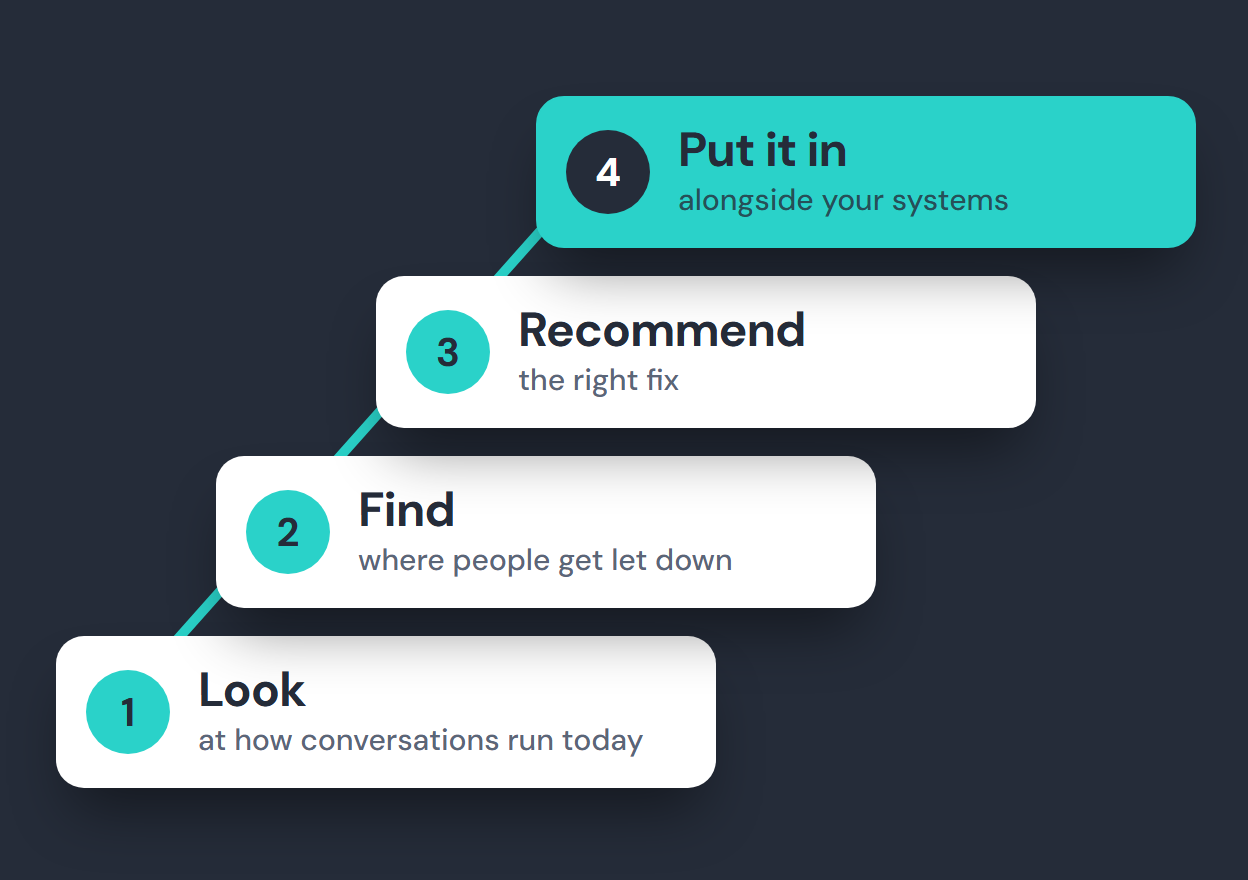
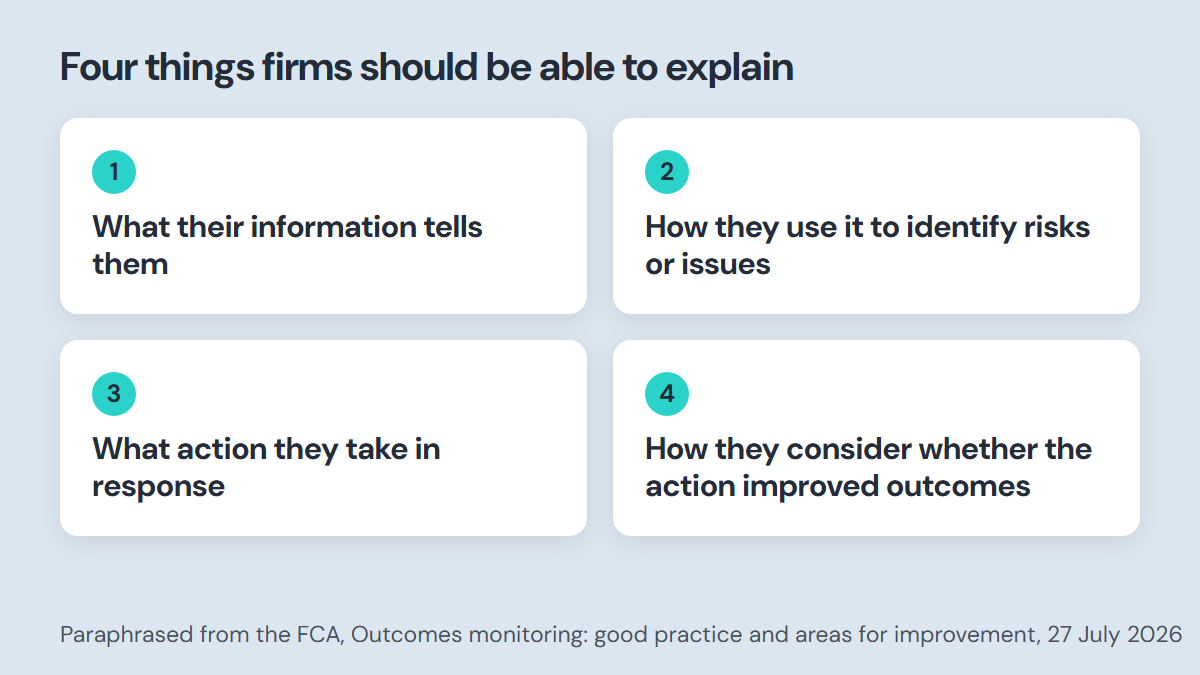
The introduction lists four things the FCA says firms should be able to explain: what their information tells them, how they use it to identify risks or issues, what action they take in response, and how they consider whether those actions have improved outcomes. Together they describe a chain from a number to a result, and a board pack that stops at the first link leaves the other three for someone to reconstruct when they are asked.
Each link needs an owner and a date. Say your pack shows average call handling time falling and complaints flat. Who decided that was good news, what did they do about it, and how would you know in three months whether the people on those calls were better served?
Firms had the MI and could not show what it led to
The review found a gap between collecting MI and acting on it. In its words, "Some firms collected relevant MI but could not show how it helped them make decisions or improve customer outcomes." It describes the stronger examples this way: "Stronger examples included a clear audit trail showing how MI translated into decisions, actions and improved outcomes."
An audit trail sounds like a system, and you can start with a page. One page per number is enough to begin with: what it showed, what was decided and when, who acted, and what changed afterwards. If nobody can fill in the page for a number your board sees every quarter, you have found a number that is reported every quarter and never acted on.
An audit trail sounds like a system, and you can start with a page. One page per number is enough to begin with: what it showed, what was decided and when, who acted, and what changed afterwards. If nobody can fill in the page for a number your board sees every quarter, you have found a number that is reported every quarter and never acted on.
Read the conversations behind the number
The review also says firms "sometimes relied on lagging indicators, lacked clear thresholds or forward-looking metrics". A complaint count is a clear example of a lagging number, because it reports on something that went wrong enough for someone to say so, and a quality score covers the calls somebody scored. The conversations behind the number show what was said while it could still be changed.
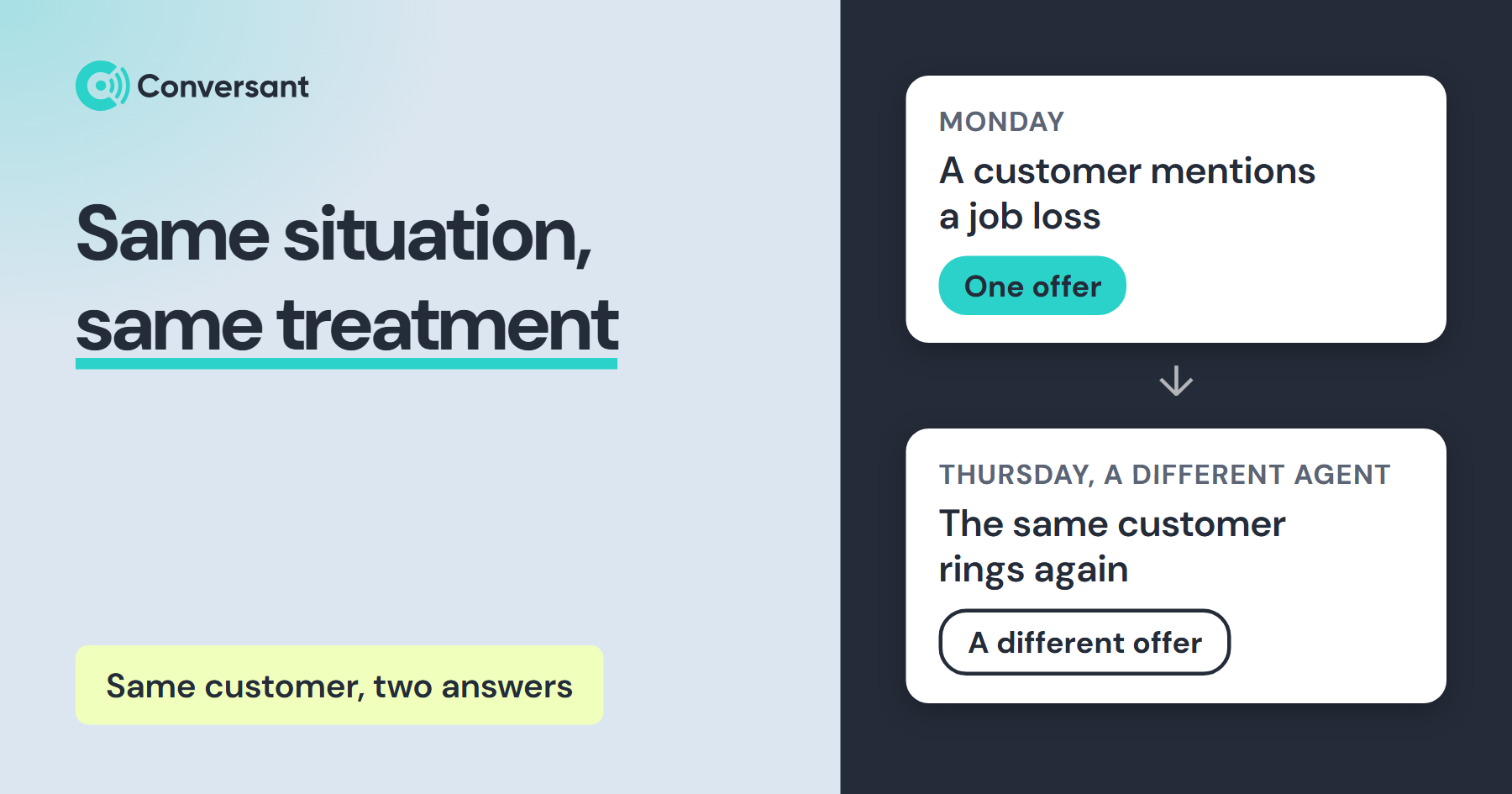
What to read depends on where you work. For a lender, it might be what an arrears call told a customer about their options. For a wealth firm, it might be whether a client review call covered the service the client pays for. For a building society, say a member rings about a payment and mentions a bereavement, and you want to know whether anyone recorded it and passed it on. Ask the people who run those calls which conversations they would least want to learn about from a complaint, and read those first.
What to read depends on where you work. For a lender, it might be what an arrears call told a customer about their options. For a wealth firm, it might be whether a client review call covered the service the client pays for. For a building society, say a member rings about a payment and mentions a bereavement, and you want to know whether anyone recorded it and passed it on. Ask the people who run those calls which conversations they would least want to learn about from a complaint, and read those first.
Trace one number from your last board pack
Choose one number from your last board pack and work through five steps.
1. Write one sentence on what the number showed and which decision it was meant to inform.
2. Write down what was decided when it was reported, and the date.
Write down the action that followed and who owns it, or write "none" if nothing followed.
3. Write down how you will know the action helped the people on the calls, and when you will look.
4. Read ten of the conversations behind the number, picked at random, and write one line on each saying whether the number describes what happened.
1. Write one sentence on what the number showed and which decision it was meant to inform.
2. Write down what was decided when it was reported, and the date.
Write down the action that followed and who owns it, or write "none" if nothing followed.
3. Write down how you will know the action helped the people on the calls, and when you will look.
4. Read ten of the conversations behind the number, picked at random, and write one line on each saying whether the number describes what happened.
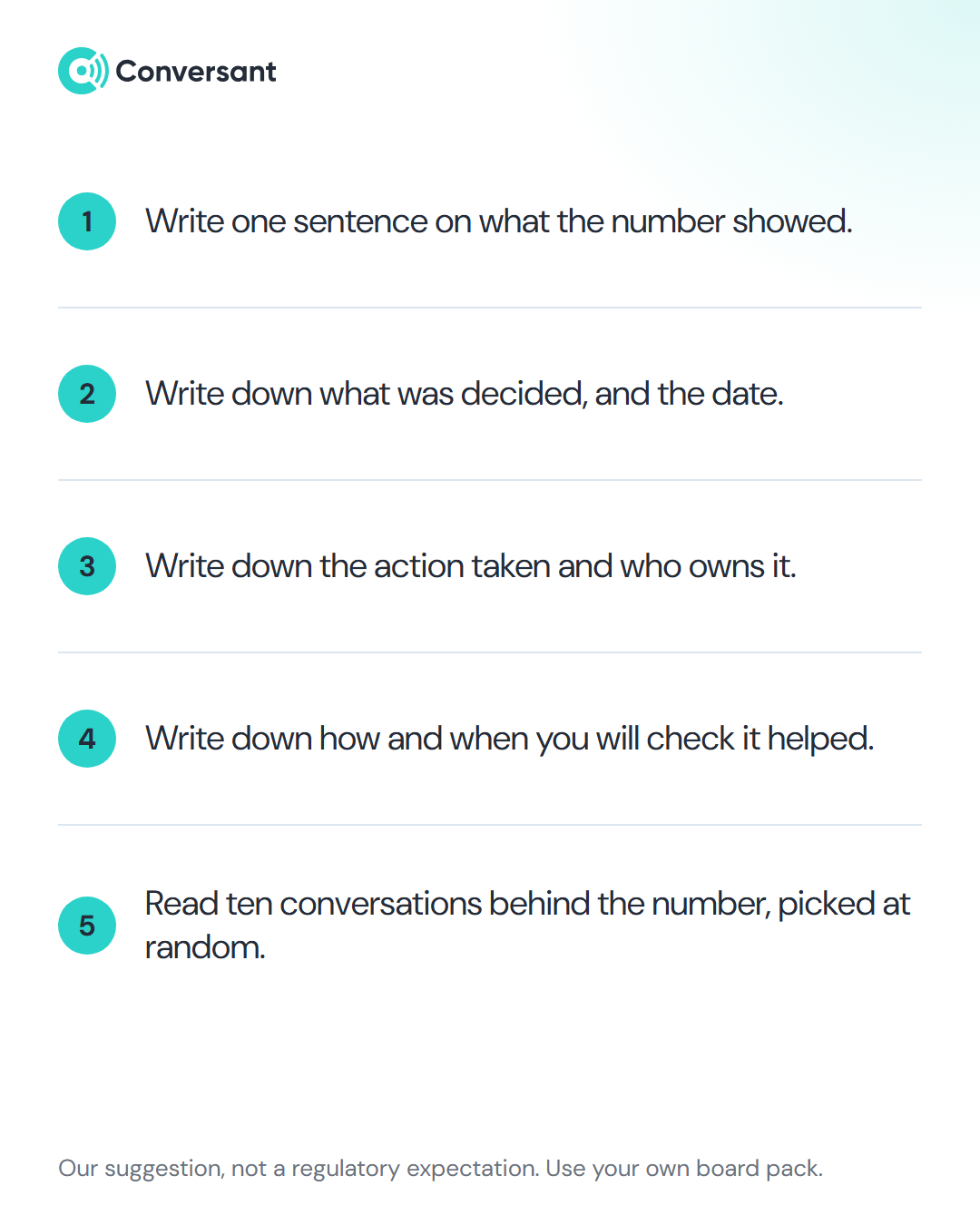
Blanks at steps 2 to 4 show you where the MI has no decision attached, which is the gap the review describes. Ten conversations the number does not describe at step 5 give you a reason to widen what your board sees, and a few real examples to show the person who decides.
What the review leaves to you
The FCA publishes this review as good and poor practice. What your own board report needs to contain is a question for your own compliance or legal people. The ten conversations at step 5 are our suggestion, and a call type that carries more risk may deserve more.
We help firms see what's really happening across their customer conversations, so problems show up early. We're happy to talk it through.
We help firms see what's really happening across their customer conversations, so problems show up early. We're happy to talk it through.
Sources
Financial Conduct Authority, Outcomes monitoring: good practice and areas for improvement, published 27 July 2026, last updated 27 July 2026. The quotations and the survey detail (56 firms) are from this page, read on 11 November 2026.