Twice a year, the FCA publishes complaints data for the firms it regulates. The next release, covering the first half of 2026, is scheduled for Thursday 22 October. It will show how many complaints firms received and across which products, which makes it useful context for your own numbers.
It will not show the cause of your own customer complaints. That sits in your own conversations, and it is the part you can change. This piece covers where to look, and an exercise you can try with ten of your recent complaints.
Why complaint totals don’t explain why customers complain
Say your own complaints number falls next quarter. It could mean you fixed something. It could equally mean fewer customers got in touch, or that a backlog is waiting to be logged. A total cannot separate those readings, because it records that a complaint happened and says nothing about what came before it.
The same applies when the number rises. One bad week, one confusing letter and one broken process all produce the same line in a report.
Use the FCA's release for what it does well, which is showing where your numbers sit alongside the market. If you compare with earlier releases, note that on 15 May 2026 the FCA updated its H1 2025 and H2 2025 data after investigating a reporting anomaly in one firm's complaints return, so use the updated figures.
Where to look for the cause of customer complaints
A complaint is often the end of a chain of earlier contact. Say a customer rings about a charge, gets one answer, rings again a week later and gets a different one, then writes in. The complaint will be logged under a category such as service or communication. That label describes the outcome, and it says little about what happened on the way.
Three patterns are worth looking for:
Three patterns are worth looking for:
- Repeat contact. Did the customer get in touch about the same thing more than once before complaining, and what differed each time?
- The same step catching people out. Do several complaints trace back to one form, hand-off or type of call?
- Different answers to the same question. Did two agents, or the call and the letter, tell one customer different things?
None of these needs new technology to spot. They need someone to work backwards from the complaint to the conversations before it.
Complaints root cause analysis: an exercise with ten complaints
When the FCA's data lands, read it for context, then give an hour or two to your own complaints.
If three of the ten start in the same place, you have a cause worth fixing. If all ten start in different places, you have learned where a count would have misled you. Both results are useful.
Ask someone from complaints and someone from operations to do it together. Each will notice different things in the same conversation, and the person who can change the process is in the room when you find the problem.
Ask someone from complaints and someone from operations to do it together. Each will notice different things in the same conversation, and the person who can change the process is in the room when you find the problem.
How to write up and sort what you find
Describe the moment itself when you write each line. Say the lines read like these (made up for illustration): "told three working days on the phone, five in the letter", "transferred twice, had to explain again", "asked for a call back, none came". Each one gives you something to fix. A line such as "poor communication" gives you a label.
Then sort the ten lines three ways: by the step in the journey, by the team that handled it, and by the channel it came through. Each grouping answers a different question. A pile by step often points to a process. A pile by team often points to a gap in knowledge or guidance. A pile by channel often points to a hand-off. Whichever pile is biggest tells you where to look first.
One practical warning. If getting to the conversations behind a complaint is slow, because recordings, emails and chat logs live in different places, that is a finding in itself, and it will slow every investigation you run after this one.
What an escalated complaint costs in 2026/27
Complaints that escalate carry a price. The Financial Ombudsman Service has set its case fee for respondent firms at £680 per case in 2026/27, with its free case allowance now a £2,000 value. That is before counting the time your own people spend on each one.
A cause you have traced and fixed can stop producing complaints of the same kind. A total, however carefully reported, leaves the cause where it was.
A cause you have traced and fixed can stop producing complaints of the same kind. A total, however carefully reported, leaves the cause where it was.
How we help you find why customers complain
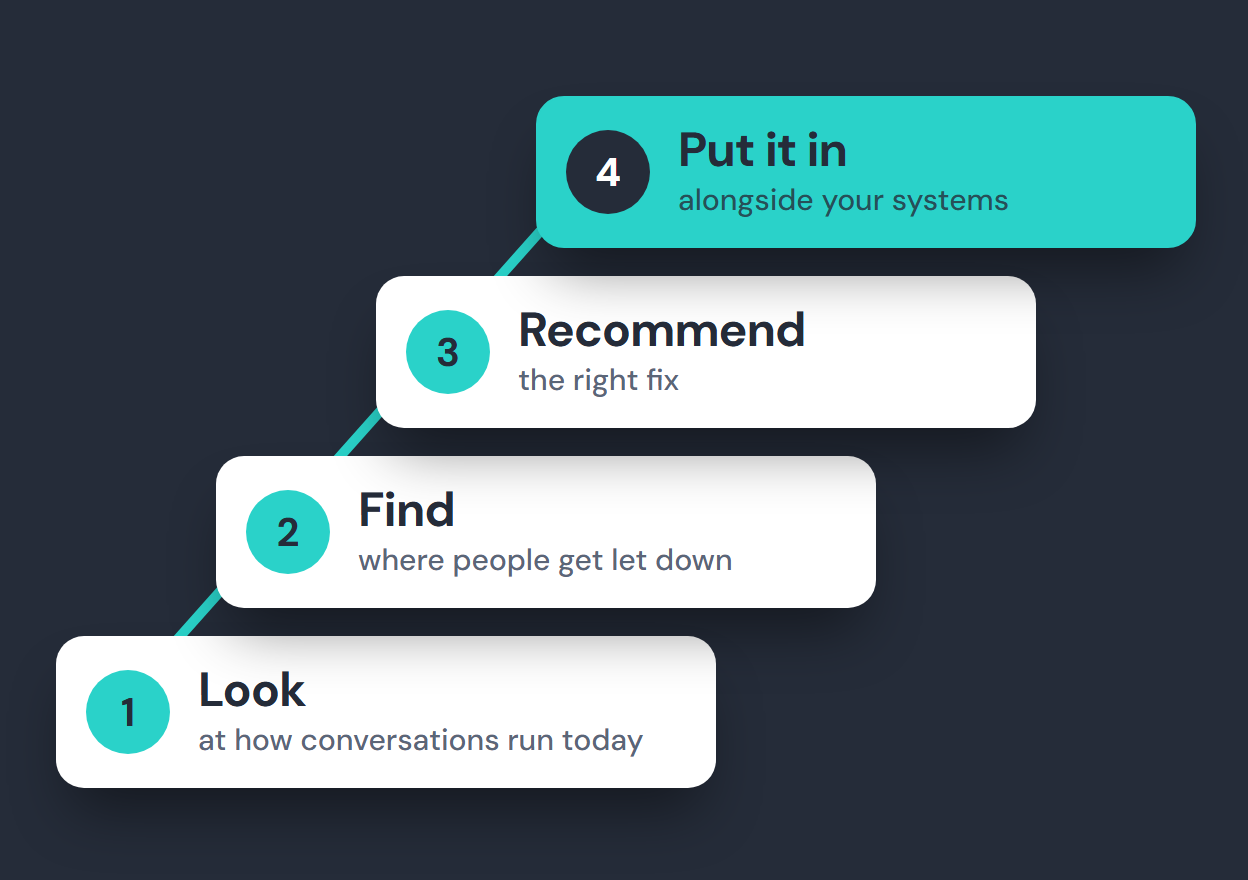
We help firms find why customers get in touch or complain, so they can fix the cause. That usually starts with looking at how your conversations actually run today, then working out the right fix, whether that is process, integration or tools.
If you'd like to talk through how you could trace complaints at your firm, we're happy to.
If you'd like to talk through how you could trace complaints at your firm, we're happy to.
Sources
- Financial Conduct Authority, Complaints data, next release (H1 2026 data) scheduled for 22 October 2026, and the 15 May 2026 update to H1 2025 and H2 2025 data: https://www.fca.org.uk/data/complaints-data (read 19 Oct 2026)
- Financial Ombudsman Service, Plans and Budget 2026/27, page 4: respondent firms charged £680 per case; free case allowance changed to a monetary value of £2,000: https://www.financial-ombudsman.org.uk/files/324743/Plans-and-Budget-2026-27-v3.pdf (read 19 Oct 2026)