How much of what’s said to your customers do you actually see?
Say call quality monitoring in your collections team means an analyst listens to ten calls from last week and scores them carefully, and the call where a customer mentioned they’d lost their job, which nobody recorded, is somewhere in the rest. The scores describe the ten, and what the other calls would have shown is the question that matters.
So the first thing to look at is what your sample leaves out. This piece covers how a sample gets its calls, what the FCA has said about checking support channels, which calls cost you most when you miss them, and a four-step exercise you can run this week with your own records.
So the first thing to look at is what your sample leaves out. This piece covers how a sample gets its calls, what the FCA has said about checking support channels, which calls cost you most when you miss them, and a four-step exercise you can run this week with your own records.
Call quality monitoring covers the calls somebody picked
Calls reach a review in a few ways: picked at random, flagged by an agent, triggered by a complaint, or chosen by the analyst because they looked interesting. Each way answers a different question. A random pick gives a fair picture of an ordinary call, a flagged call shows what that agent chose to raise, a complaint-triggered call shows something that already went wrong badly enough to be reported, and an analyst’s choice shows what caught one person’s eye.
Say the ten calls are picked at random. A call that went wrong then has no better chance of being one of them than any other call, so it stays unheard unless it happens to be picked, and the score you give the ten is a fair score for the ten and no more. The same holds in a wealth firm, where a client review that nobody can evidence sits outside the ten in exactly the same way, and a good result on the ten says nothing about it.
None of this is a case against sampling, which is a sensible way to look at a lot of calls with a small team. The risk is treating the sample as the whole picture, and the way to avoid that is to know what it leaves out.
The FCA found firms with no quality assurance at all
The FCA’s review of consumer support looked at how firms check the channels they offer, and it reported that “13% of firms we surveyed told us that they don’t carry out any quality assurance on the support channels they offer.”
If you review calls at all, you are already doing more than those firms, so the more useful comparison is with your own picture. If someone asked what was said on your arrears calls last month, how much of it could you show them, and how much of it has anyone listened to? With a sample of ten, the honest answer is ten calls, and the rest is whatever your records and the people on those calls can tell you.
The FCA names proactive tools as good practice
In the same review the FCA cites “proactive tools (such as speech analytics technology in call centres)” as good practice for assessing the quality of support, and you can ask the question behind that line before you look at any tool. How would you find the call that went wrong without waiting for a complaint to point you to it?
Answering that takes three decisions that no tool makes for you: which calls matter most to you, what a good version of each looks like in your own words, and who reads what comes out and acts on it. Settle those on paper first and any tool you add later has something to check against, and if you never add one you still have a clearer review than you started with.
Which calls cost you most when you miss them
Start with the call types where a miss does the most damage, because those are the ones to see more of first. For a lender, that might be arrears and forbearance calls, where a customer mentions a difficulty that the next agent needs to know about and the record is the only way they will. For a wealth firm, it might be client review calls, where the conversation is the evidence that the client got the service they paid for. For an insurer, it might be claims calls.
You know your own list better than any article does. Ask the people who run those calls which ones they would least want to find out about from a complaint, and write those down.
You know your own list better than any article does. Ask the people who run those calls which ones they would least want to find out about from a complaint, and write those down.
Ask what your sample leaves out
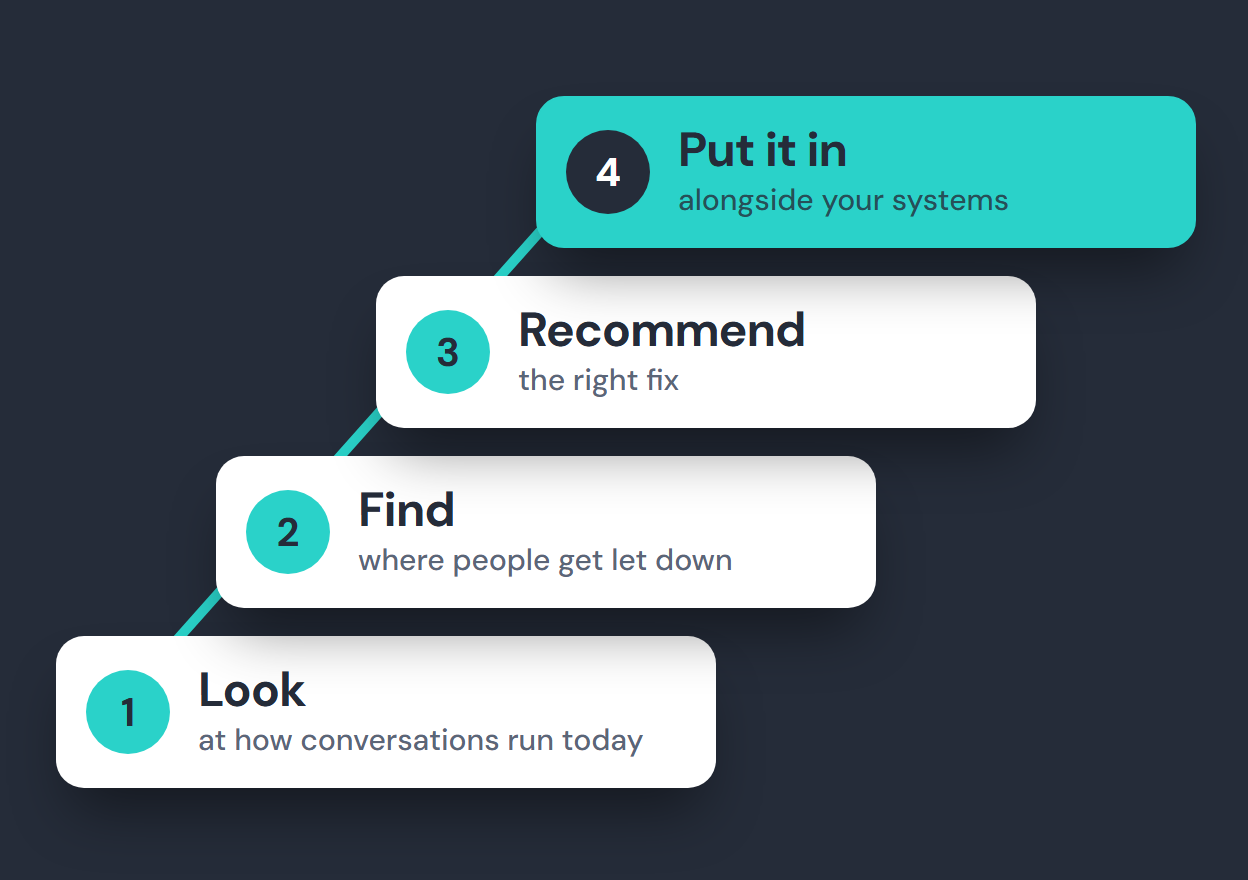
Four steps, for one call type from that list:
- Write down how a call of that type gets into your review today (picked at random, flagged by an agent, triggered by a complaint or chosen by the analyst), so you know which of those sets you are looking at.
- Over one month, count how many calls of that type there were and how many anyone listened to, using your own call records rather than an estimate.
- Read ten of the calls nobody listened to, picked at random from the rest, and write one line on each saying whether there is anything in it you would have wanted to know sooner.
- Write the result as two plain numbers and one sentence: calls of this type, calls anyone heard, and what the ten showed.
What to do with what you find
The two numbers show how much of that call type you don’t see, and the ten lines show whether it matters. If the ten are routine, you have learned that the calls outside your sample look like the ones inside it, and you can keep that as evidence for the sample you have. If some of the ten show something you would have wanted to know sooner, you have a reason to widen the sample for that call type, and a few real examples to show the person who decides.
Share the ten lines with whoever owns that call type and ask what they would change, then run the same count next month so the numbers show whether the change did anything.
Share the ten lines with whoever owns that call type and ask what they would change, then run the same count next month so the numbers show whether the change did anything.
What the FCA’s figure leaves open
The FCA’s 13% counts firms, and it says nothing about how many calls any of them review, so it can’t tell you whether ten is enough. The exercise gives you your own answer for each call type, and the answer can differ between them. If you are unsure what you are expected to review, check with your own compliance or legal people.
We help firms see what’s really happening across their customer conversations, so problems show up early. We’re happy to talk it through.
Source: Financial Conduct Authority, Consumer support outcome: good practices and areas for improvement, published 7 March 2025, updated 10 July 2026. Both quotations are from this page, checked 26 October 2026.