
The big question: Will AI replace customer service jobs? There’s a familiar narrative in the contact centre world: AI is coming for agents’ jobs.
It’s a headline that gets attention, but in reality it's something that may necessarily not be true. It’s not an irrational fear. Headlines regularly warn that millions of roles could be displaced, with some estimates suggesting tens of millions of jobs will be affected globally by AI over the next decade. At the same time, surveys show growing anxiety among workers, with a significant proportion believing their own roles could be at risk.
This concern has spread far beyond traditionally “automatable” roles. It’s no longer just manufacturing or repetitive tasks under scrutiny, it’s analysts, writers, developers, and even customer service professionals. The narrative has shifted from “AI will change work” to “AI will replace workers.”
But here’s where the conversation often goes wrong.
Much of the data doesn’t actually point to full job replacement, it points to task-level transformation. In many cases, AI isn’t removing entire roles, but reshaping how those roles function, automating specific activities rather than eliminating the need for humans altogether. AI in the technology and customer service sector now enables staff and managers to dig deeper and find out more information about their customers, without spending hours on these tasks.
And so, in some ways you can say AI is actually essential for some roles.
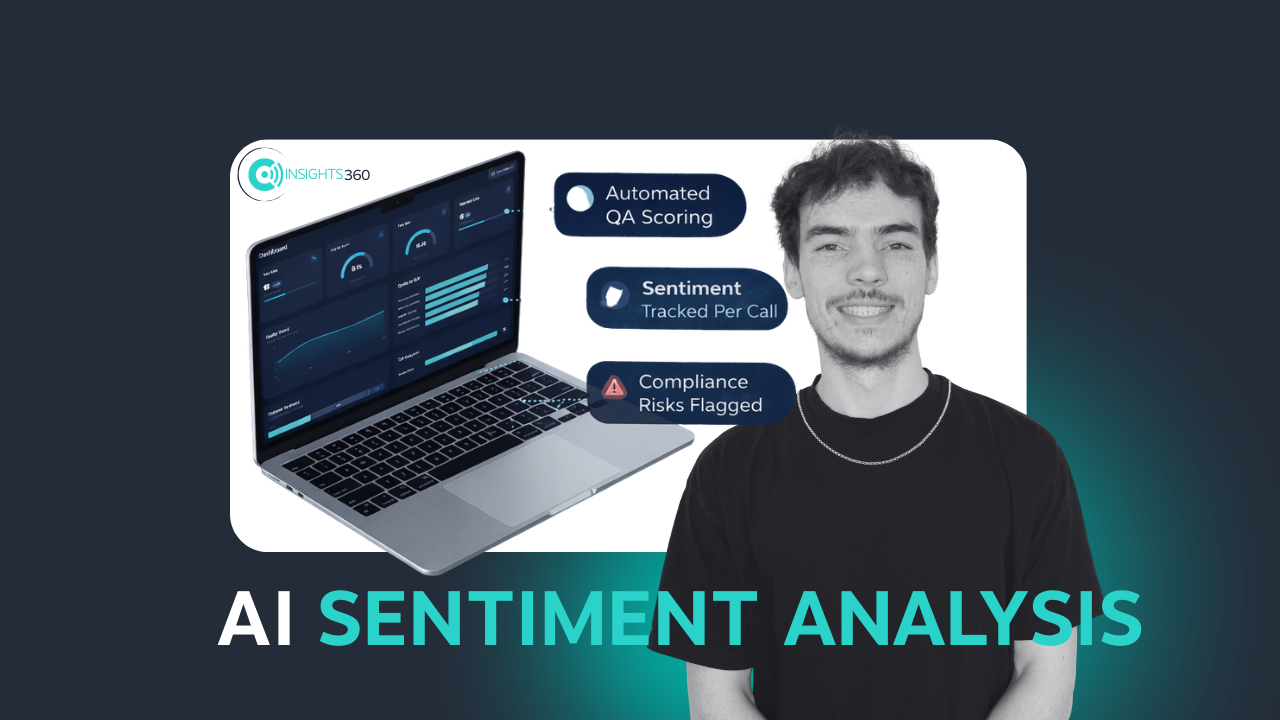
With platforms like Insights360 and the rise of AI-powered sentiment analysis, the role of AI has shifted. It’s no longer just about automation or deflection. Instead, it’s about visibility. It’s about finally seeing, at scale, what customers are experiencing and how those experiences are shaped.
And in many cases, that visibility is revealing something organisations weren’t expecting.
Not that agents are failing, but that the systems, processes, and structures around them often are.
It’s a headline that gets attention, but in reality it's something that may necessarily not be true. It’s not an irrational fear. Headlines regularly warn that millions of roles could be displaced, with some estimates suggesting tens of millions of jobs will be affected globally by AI over the next decade. At the same time, surveys show growing anxiety among workers, with a significant proportion believing their own roles could be at risk.
This concern has spread far beyond traditionally “automatable” roles. It’s no longer just manufacturing or repetitive tasks under scrutiny, it’s analysts, writers, developers, and even customer service professionals. The narrative has shifted from “AI will change work” to “AI will replace workers.”
But here’s where the conversation often goes wrong.
Much of the data doesn’t actually point to full job replacement, it points to task-level transformation. In many cases, AI isn’t removing entire roles, but reshaping how those roles function, automating specific activities rather than eliminating the need for humans altogether. AI in the technology and customer service sector now enables staff and managers to dig deeper and find out more information about their customers, without spending hours on these tasks.
And so, in some ways you can say AI is actually essential for some roles.
With platforms like Insights360 and the rise of AI-powered sentiment analysis, the role of AI has shifted. It’s no longer just about automation or deflection. Instead, it’s about visibility. It’s about finally seeing, at scale, what customers are experiencing and how those experiences are shaped.
And in many cases, that visibility is revealing something organisations weren’t expecting.
Not that agents are failing, but that the systems, processes, and structures around them often are.
From automation to understanding
For years, AI in customer experience was framed as a way to reduce workload. Chatbots, self-service, and automation were all positioned as tools to handle volume and lower costs.
But that was only the first chapter.
Today, AI is increasingly being used to analyse conversations rather than replace them. Every call, every interaction, every moment of friction can now be captured, interpreted, and understood. Instead of reviewing a handful of calls and making assumptions, organisations can access a complete picture of performance and experience.
This is where sentiment analysis becomes powerful. Not as a surface-level label of “positive” or “negative,” but as a way to track emotional shifts throughout an interaction. It shows where frustration begins, how it escalates, and what influence the agent has in either resolving or reinforcing it.
With Insights360, this kind of analysis becomes continuous rather than occasional. It moves organisations away from isolated snapshots and towards a living, evolving understanding of their customer conversations.
But that was only the first chapter.
Today, AI is increasingly being used to analyse conversations rather than replace them. Every call, every interaction, every moment of friction can now be captured, interpreted, and understood. Instead of reviewing a handful of calls and making assumptions, organisations can access a complete picture of performance and experience.
This is where sentiment analysis becomes powerful. Not as a surface-level label of “positive” or “negative,” but as a way to track emotional shifts throughout an interaction. It shows where frustration begins, how it escalates, and what influence the agent has in either resolving or reinforcing it.
With Insights360, this kind of analysis becomes continuous rather than occasional. It moves organisations away from isolated snapshots and towards a living, evolving understanding of their customer conversations.
What AI really uncovers
Once you start analysing conversations at scale, patterns begin to emerge, and they’re often surprising.
What looks like an agent issue on the surface frequently turns out to be something deeper. A frustrated customer might not be reacting to the agent at all, but to a broken process, unclear communication, or a gap between expectation and delivery.
AI has a way of cutting through assumptions. It highlights inconsistencies in training, moments where scripts don’t align with real-world conversations, and situations where agents are forced to navigate problems they didn’t create.
In doing so, it challenges a long-standing instinct in many organisations: to focus on agent performance in isolation.
Instead, it reframes the question entirely.
If multiple agents are encountering the same friction points, is it really an agent problem, or a systemic one?
What looks like an agent issue on the surface frequently turns out to be something deeper. A frustrated customer might not be reacting to the agent at all, but to a broken process, unclear communication, or a gap between expectation and delivery.
AI has a way of cutting through assumptions. It highlights inconsistencies in training, moments where scripts don’t align with real-world conversations, and situations where agents are forced to navigate problems they didn’t create.
In doing so, it challenges a long-standing instinct in many organisations: to focus on agent performance in isolation.
Instead, it reframes the question entirely.
If multiple agents are encountering the same friction points, is it really an agent problem, or a systemic one?
A clearer picture of performance
One of the most valuable shifts AI enables is moving from anecdotal feedback to evidence-based insight.
Rather than relying on small samples or subjective interpretations, leaders can see patterns across thousands of interactions, without spending hours sifting through information themselves. They can identify what high-performing agents do differently, not as a matter of opinion, but as a repeatable, observable behaviour.
At the same time, they can spot where even strong agents struggle. These moments are often the most revealing, because they point directly to issues that training alone won’t fix.
This creates a more balanced and fair view of performance. Agents are no longer judged solely on outcomes, but understood within the context of the challenges they face.
And that changes the conversation from one of scrutiny to one of support.
Rather than relying on small samples or subjective interpretations, leaders can see patterns across thousands of interactions, without spending hours sifting through information themselves. They can identify what high-performing agents do differently, not as a matter of opinion, but as a repeatable, observable behaviour.
At the same time, they can spot where even strong agents struggle. These moments are often the most revealing, because they point directly to issues that training alone won’t fix.
This creates a more balanced and fair view of performance. Agents are no longer judged solely on outcomes, but understood within the context of the challenges they face.
And that changes the conversation from one of scrutiny to one of support.
Why this matters now
Customer expectations haven’t just increased, they’ve become less forgiving, especially with the rise of social media. A single frustrating interaction can undo years of loyalty, and customers are quicker than ever to move on.
At the same time, contact centres are under pressure to do more with less. Efficiency matters, but so does experience, and the two are often in tension.
This is where AI-driven insight becomes essential. It allows organisations to address root causes rather than surface symptoms. Instead of repeatedly coaching agents through the same issues, they can fix the underlying problems that create those issues in the first place.
Insights360 plays a key role here by turning conversation data into something actionable. It doesn’t just show what happened, it helps explain why it happened, and where to focus next.
At the same time, contact centres are under pressure to do more with less. Efficiency matters, but so does experience, and the two are often in tension.
This is where AI-driven insight becomes essential. It allows organisations to address root causes rather than surface symptoms. Instead of repeatedly coaching agents through the same issues, they can fix the underlying problems that create those issues in the first place.
Insights360 plays a key role here by turning conversation data into something actionable. It doesn’t just show what happened, it helps explain why it happened, and where to focus next.
The role of the agent in an AI-driven world
The idea that AI will replace agents assumes that customer interactions are purely transactional. In reality, they’re often emotional, complex, and unpredictable.
These are precisely the moments where human agents are most valuable.
What AI does is remove the guesswork around those interactions. It equips organisations with the insight needed to support agents more effectively, refine their processes, and create conditions where good performance is easier to achieve.
Rather than replacing agents, AI elevates them. It helps identify what works, highlights where support is needed, and ensures that improvement efforts are grounded in reality.
These are precisely the moments where human agents are most valuable.
What AI does is remove the guesswork around those interactions. It equips organisations with the insight needed to support agents more effectively, refine their processes, and create conditions where good performance is easier to achieve.
Rather than replacing agents, AI elevates them. It helps identify what works, highlights where support is needed, and ensures that improvement efforts are grounded in reality.
Final thought
AI isn’t here to take your agents’ place.
It’s here to show you what’s really happening when they speak to your customers.
Sometimes that means uncovering uncomfortable truths. But more importantly, it creates an opportunity, to fix what’s broken, to support your teams more effectively, and to build experiences that actually meet customer expectations.
In the end, the value of AI isn’t in what it replaces.
It’s in what it reveals.
It’s here to show you what’s really happening when they speak to your customers.
Sometimes that means uncovering uncomfortable truths. But more importantly, it creates an opportunity, to fix what’s broken, to support your teams more effectively, and to build experiences that actually meet customer expectations.
In the end, the value of AI isn’t in what it replaces.
It’s in what it reveals.