
Customer experience has long been measured by efficiency; average handling time, speed to resolution, call volumes and service levels.
For years, these metrics defined success in the contact centre. But over the past few months, something has fundamentally changed and many customer experience teams are only just starting to notice.
Customers aren’t contacting support calm anymore.
They’ve already tried self-service.
They’ve read the help article.
They’ve waited.
By the time they reach a human agent, frustration is already part of the conversation.
And that shift is redefining what great customer experience actually looks like.
For years, these metrics defined success in the contact centre. But over the past few months, something has fundamentally changed and many customer experience teams are only just starting to notice.
Customers aren’t contacting support calm anymore.
They’ve already tried self-service.
They’ve read the help article.
They’ve waited.
By the time they reach a human agent, frustration is already part of the conversation.
And that shift is redefining what great customer experience actually looks like.
Customer Conversations Are Becoming More Emotional
Modern customer conversations are longer, messier, and significantly more emotional than they used to be.
Agents are no longer just answering questions. Increasingly, they’re de-escalating tension, reassuring frustrated customers, and managing tone and emotion in real time. In many interactions, the emotional state of the customer matters just as much as the issue itself.
This shift is exactly what triggered our own research.
As we looked more closely at contact centre data and spoke to CX and operations leaders, a consistent pattern emerged: teams could see what was happening in conversations, but had very limited insight into how those conversations felt.
Agents are no longer just answering questions. Increasingly, they’re de-escalating tension, reassuring frustrated customers, and managing tone and emotion in real time. In many interactions, the emotional state of the customer matters just as much as the issue itself.
This shift is exactly what triggered our own research.
As we looked more closely at contact centre data and spoke to CX and operations leaders, a consistent pattern emerged: teams could see what was happening in conversations, but had very limited insight into how those conversations felt.
The limits of traditional CX metrics
Most contact centres still rely on speed, volume, and compliance as their primary measures of success. These metrics are essential, but they miss something critical.
They don’t tell you whether an agent actually turned a bad moment around.
They don’t show whether a customer left calmer than when they arrived.
Two agents can resolve the same issue in the same amount of time, using the same process, and produce completely different outcomes, purely based on tone, empathy, and emotional awareness.
That gap between operational performance and emotional outcome was the clearest signal in our research.
They don’t tell you whether an agent actually turned a bad moment around.
They don’t show whether a customer left calmer than when they arrived.
Two agents can resolve the same issue in the same amount of time, using the same process, and produce completely different outcomes, purely based on tone, empathy, and emotional awareness.
That gap between operational performance and emotional outcome was the clearest signal in our research.
Why Sentiment Is the Missing Layer in CX Analytics
As customer experience becomes more human, CX analytics needs to evolve with it.
Leaders are starting to recognise that operational data alone doesn’t reflect what’s really happening inside customer conversations. What’s missing is visibility into human signals, such as:
Leaders are starting to recognise that operational data alone doesn’t reflect what’s really happening inside customer conversations. What’s missing is visibility into human signals, such as:
- Customer sentiment
- Agent tone
- Emotional patterns across conversations
- How sentiment changes from the start of a call to the end
Without this insight, organisations can’t see whether conversations are genuinely improving customer relationships, or quietly damaging them.
This is where AI changes what’s possible.
AI makes it possible to analyse sentiment across every conversation, identify emotional patterns over time, and understand whether interactions are reducing friction or quietly creating more of it.
Not just whether an issue was resolved, but how the customer felt by the end of the interaction.
This is where AI changes what’s possible.
AI makes it possible to analyse sentiment across every conversation, identify emotional patterns over time, and understand whether interactions are reducing friction or quietly creating more of it.
Not just whether an issue was resolved, but how the customer felt by the end of the interaction.
The Role of AI Sentiment Analysis in Customer Experience
This is where AI sentiment analysis is changing the future of customer experience.
Analysing tone, emotion, and sentiment at scale simply isn’t possible through manual quality assurance or post-call surveys alone. AI allows organisations to:
Analysing tone, emotion, and sentiment at scale simply isn’t possible through manual quality assurance or post-call surveys alone. AI allows organisations to:
- Understand how conversations feel, not just how they end
- Identify patterns in emotional escalation or de-escalation
- Support agents with better insight, not just performance targets
- Measure CX outcomes beyond speed and compliance
Instead of guessing which conversations went well, teams gain clear visibility into emotional outcomes across every interaction.
Designing Insights360 Around Real-World Constraints
That insight shaped how we designed Insights360.
From the beginning, the goal wasn’t to build another standalone analytics tool or replace existing platforms. The reality we saw in the market was clear: contact centres already run on complex, interconnected systems. Adding more layers of tooling only increases friction.
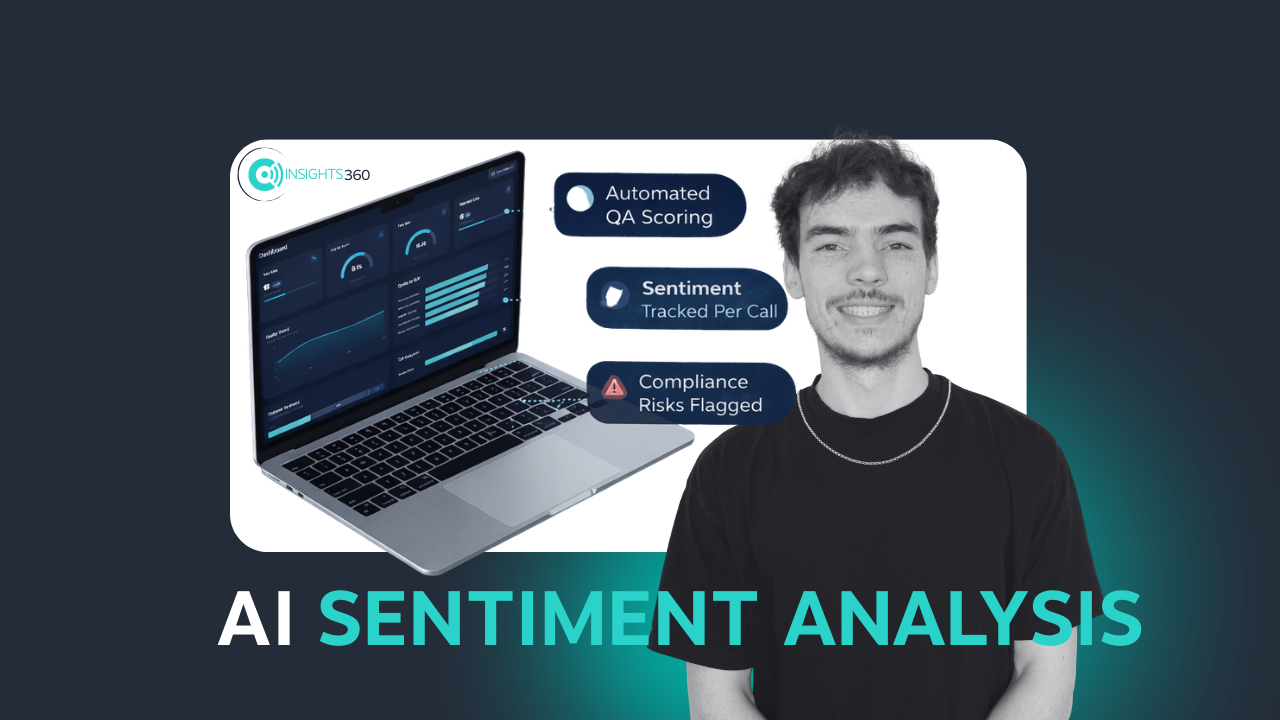
Insights360 was designed to plug into existing environments, working alongside current contact centre platforms rather than disrupting them. AI sentiment analysis runs in the background, enriching the data teams already have with emotional context, without adding operational complexity for agents or leaders.
The focus was always on practical insight, not novelty.
From the beginning, the goal wasn’t to build another standalone analytics tool or replace existing platforms. The reality we saw in the market was clear: contact centres already run on complex, interconnected systems. Adding more layers of tooling only increases friction.
Insights360 was designed to plug into existing environments, working alongside current contact centre platforms rather than disrupting them. AI sentiment analysis runs in the background, enriching the data teams already have with emotional context, without adding operational complexity for agents or leaders.
The focus was always on practical insight, not novelty.
From Operational Data to Emotional Insight
By combining market research, real customer conversations, and advances in AI, Insights360 bridges a gap that has existed in customer experience for years.
It gives teams visibility into:
It gives teams visibility into:
- How sentiment shifts during conversations
- Which interactions consistently reduce friction
- Where emotional escalation is happening, and why
This allows leaders to support agents more effectively, improve coaching, and make decisions based on how customers actually experience conversations, not just how efficiently they’re handled.
Where Customer Experience Is Heading Next
The next evolution of customer experience isn’t about faster conversations.
It’s about better ones.
It’s about recognising that emotional outcomes are just as important as operational metrics and designing systems that reflect that reality.
As customer conversations continue to change, the organisations that succeed will be the ones that learn to listen differently.
And that’s exactly the problem Insights360 was built to solve.
It’s about better ones.
It’s about recognising that emotional outcomes are just as important as operational metrics and designing systems that reflect that reality.
As customer conversations continue to change, the organisations that succeed will be the ones that learn to listen differently.
And that’s exactly the problem Insights360 was built to solve.