
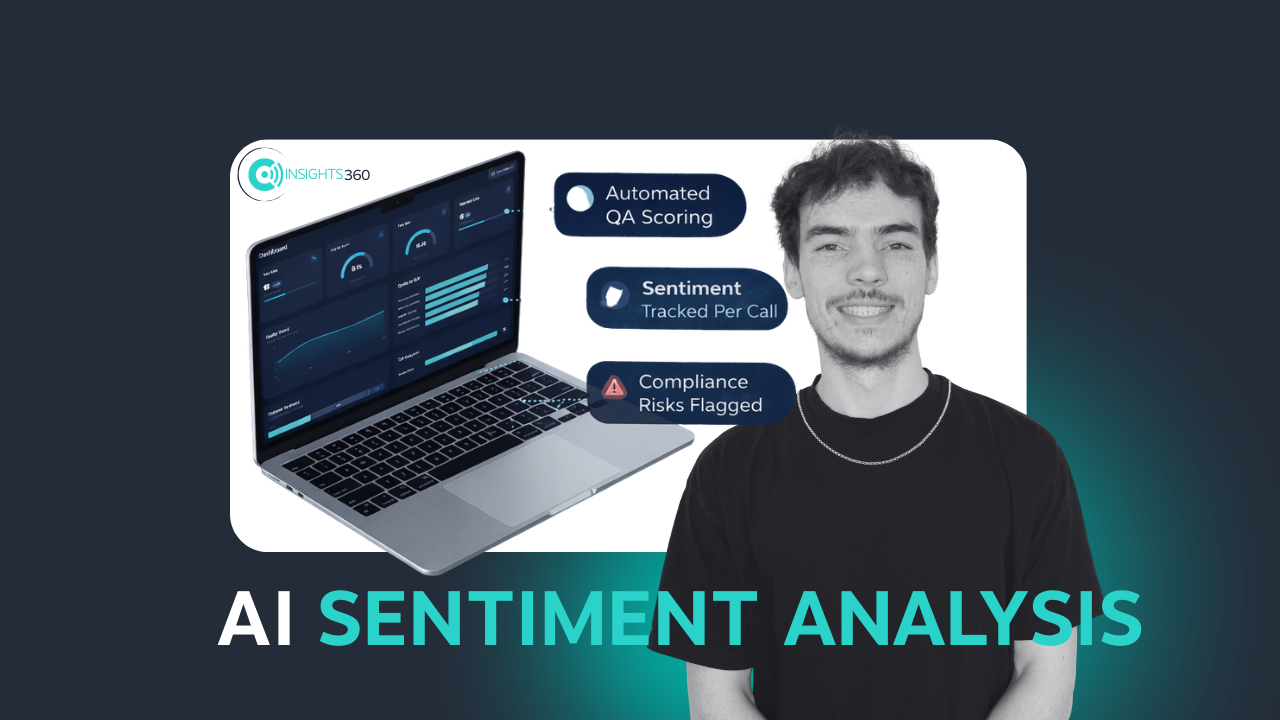
Measuring customer sentiment with AI has become a necessity in 2026 and so understanding how your customers feel about your brand is no longer a "nice to have", it’s a critical driver of growth, retention, and competitive advantage. In an era where every interaction leaves a digital footprint, organisations have more data than ever before. The challenge isn’t access, it’s making sense of it.
In this blog, we’ll explore how organisations can measure customer sentiment effectively, the most common methods available today, and how AI-powered tools like Insights360 are transforming the process.
In this blog, we’ll explore how organisations can measure customer sentiment effectively, the most common methods available today, and how AI-powered tools like Insights360 are transforming the process.
What is Customer Sentiment?
Customer sentiment refers to the emotional tone behind customer interactions, feedback, and behaviour. It answers a simple but powerful question: how do your customers really feel about your business?
Rather than existing as a single metric, sentiment typically sits on a spectrum. Customers may feel positively toward your brand, showing satisfaction and loyalty; they may feel neutral, indicating indifference or mixed experiences; or they may express negative sentiment, often signalling frustration or a potential risk of churn.
Understanding these emotional signals allows organisations to move beyond surface-level metrics and uncover the true customer experience.
Rather than existing as a single metric, sentiment typically sits on a spectrum. Customers may feel positively toward your brand, showing satisfaction and loyalty; they may feel neutral, indicating indifference or mixed experiences; or they may express negative sentiment, often signalling frustration or a potential risk of churn.
Understanding these emotional signals allows organisations to move beyond surface-level metrics and uncover the true customer experience.
Why Measuring Customer Sentiment Matters
Organisations that actively track and respond to customer sentiment gain a much deeper understanding of their customer experience. Instead of relying solely on what customers do, such as purchasing or cancelling, they can understand why those behaviours occur.
This has a direct impact across the business. Customer experience improves because teams can respond more effectively to feedback. Retention increases as organisations identify and address issues earlier. Product and service development becomes more informed, shaped by real customer insight rather than assumption. Over time, this leads to stronger brand perception and more meaningful customer relationships.
In short, sentiment provides the missing context between customer behaviour and business outcomes.
This has a direct impact across the business. Customer experience improves because teams can respond more effectively to feedback. Retention increases as organisations identify and address issues earlier. Product and service development becomes more informed, shaped by real customer insight rather than assumption. Over time, this leads to stronger brand perception and more meaningful customer relationships.
In short, sentiment provides the missing context between customer behaviour and business outcomes.
Traditional Methods of Measuring Customer Sentiment
1. Surveys and Feedback Forms
Surveys such as CSAT (Customer Satisfaction Score) and NPS (Net Promoter Score) have long been used to gauge sentiment. They are relatively easy to implement and provide structured, quantifiable data. However, they often suffer from low response rates and can present a skewed view of customer opinion. Most importantly, they capture sentiment at a single moment in time rather than continuously.
2. Social Media Monitoring
Monitoring social media allows organisations to observe how customers talk about their brand in real time. This can offer valuable insight into public perception and emerging trends. That said, it only represents a subset of customers and can be difficult to interpret accurately without context, especially at scale.
3. Call Centre Analysis
Customer service interactions are one of the richest sources of sentiment data. Conversations often contain detailed, emotional feedback that can highlight both strengths and pain points. The challenge lies in analysing this data efficiently, as traditional approaches rely heavily on manual review or limited sampling.
The Limitations of Traditional Approaches
While these methods provide valuable insights, they tend to operate in isolation. Data is often spread across multiple systems, making it difficult to build a complete picture of customer sentiment.
Manual analysis also presents a significant barrier. As interaction volumes grow, it becomes increasingly difficult to review and interpret data at scale. This leads to delays in identifying issues and missed opportunities to act on customer feedback in the moment.
Perhaps most importantly, traditional approaches often fail to capture the nuance of human emotion consistently. Without the ability to analyse every interaction, organisations are left relying on partial insights rather than a true reflection of customer experience.
Manual analysis also presents a significant barrier. As interaction volumes grow, it becomes increasingly difficult to review and interpret data at scale. This leads to delays in identifying issues and missed opportunities to act on customer feedback in the moment.
Perhaps most importantly, traditional approaches often fail to capture the nuance of human emotion consistently. Without the ability to analyse every interaction, organisations are left relying on partial insights rather than a true reflection of customer experience.
The Role of AI in Sentiment Analysis
Artificial intelligence has fundamentally changed how organisations approach sentiment analysis. Rather than relying on small samples or delayed feedback, AI enables the analysis of large volumes of customer interactions in real time.
By processing conversations across voice, chat, email, and social channels, AI can detect emotional tone, intent, and recurring themes with a level of consistency that manual methods cannot achieve. It also allows organisations to identify trends and anomalies as they emerge, turning raw data into actionable insight much faster.
This shift is what makes modern sentiment analysis not just more efficient, but significantly more valuable.
By processing conversations across voice, chat, email, and social channels, AI can detect emotional tone, intent, and recurring themes with a level of consistency that manual methods cannot achieve. It also allows organisations to identify trends and anomalies as they emerge, turning raw data into actionable insight much faster.
This shift is what makes modern sentiment analysis not just more efficient, but significantly more valuable.
Measuring Customer Sentiment with Insights360
Insights360 is designed to give organisations a complete, real-time view of customer sentiment without disrupting existing systems.
One of the key advantages is its ability to integrate seamlessly with your current technology stack. Whether you’re using contact centre platforms, CRM systems, messaging tools, or telephony environments, Insights360 layers intelligence on top of what you already have, eliminating the need for costly replacements.
It also moves beyond traditional sampling by analysing every customer interaction. This provides a far more accurate and representative view of sentiment across the entire customer journey, removing blind spots that can distort decision-making.
Real-time insight is another critical factor. With immediate visibility into customer sentiment, organisations can respond proactively to negative experiences, support teams more effectively, and resolve issues before they escalate.
Beyond individual interactions, Insights360 helps uncover broader patterns. By identifying recurring themes and root causes, businesses can address systemic issues, improve processes, and enhance overall customer experience.
One of the key advantages is its ability to integrate seamlessly with your current technology stack. Whether you’re using contact centre platforms, CRM systems, messaging tools, or telephony environments, Insights360 layers intelligence on top of what you already have, eliminating the need for costly replacements.
It also moves beyond traditional sampling by analysing every customer interaction. This provides a far more accurate and representative view of sentiment across the entire customer journey, removing blind spots that can distort decision-making.
Real-time insight is another critical factor. With immediate visibility into customer sentiment, organisations can respond proactively to negative experiences, support teams more effectively, and resolve issues before they escalate.
Beyond individual interactions, Insights360 helps uncover broader patterns. By identifying recurring themes and root causes, businesses can address systemic issues, improve processes, and enhance overall customer experience.
Best Practices for Measuring Customer Sentiment Effectively
To measure customer sentiment effectively, organisations need to take a holistic and consistent approach.
It starts with combining multiple data sources. Relying on a single channel will always provide an incomplete picture, whereas bringing together voice, text, and digital interactions creates a more accurate view of the customer experience.
Speed is equally important. The value of sentiment insight increases significantly when it can be acted on in real time, allowing organisations to address issues as they happen rather than after the fact.
It’s also essential to move beyond simple scores. Metrics like NPS provide a useful benchmark, but they don’t explain the underlying reasons behind customer behaviour. Deeper analysis is needed to uncover the drivers of sentiment.
Finally, organisations must ensure that insights are shared across the business. When sentiment data is accessible to multiple teams, it becomes a powerful tool for improving not just customer service, but product development, operations, and overall strategy.
It starts with combining multiple data sources. Relying on a single channel will always provide an incomplete picture, whereas bringing together voice, text, and digital interactions creates a more accurate view of the customer experience.
Speed is equally important. The value of sentiment insight increases significantly when it can be acted on in real time, allowing organisations to address issues as they happen rather than after the fact.
It’s also essential to move beyond simple scores. Metrics like NPS provide a useful benchmark, but they don’t explain the underlying reasons behind customer behaviour. Deeper analysis is needed to uncover the drivers of sentiment.
Finally, organisations must ensure that insights are shared across the business. When sentiment data is accessible to multiple teams, it becomes a powerful tool for improving not just customer service, but product development, operations, and overall strategy.
The Future of Customer Sentiment Analysis
As customer expectations continue to rise, organisations that can understand and act on sentiment in real time will have a clear advantage.
AI-driven platforms like Insights360 are not just enhancing sentiment analysis, they’re redefining it. By turning every interaction into actionable insight, businesses can create more personalised, responsive, and meaningful customer experiences.
AI-driven platforms like Insights360 are not just enhancing sentiment analysis, they’re redefining it. By turning every interaction into actionable insight, businesses can create more personalised, responsive, and meaningful customer experiences.
Final Thoughts
Measuring customer sentiment effectively is no longer about collecting more data, it’s about unlocking the value within it.
By combining AI-powered analysis with seamless integration, solutions like Insights360 enable organisations to move from guesswork to genuine understanding.
And in today’s competitive landscape, that understanding is what sets leading organisations apart.
By combining AI-powered analysis with seamless integration, solutions like Insights360 enable organisations to move from guesswork to genuine understanding.
And in today’s competitive landscape, that understanding is what sets leading organisations apart.