If You Haven’t Defined What “Good” Agent Performance Looks Like, You Can’t Expect It to Happen
In today’s customer experience landscape, contact centres are under constant pressure to deliver faster resolutions, higher satisfaction scores, and more personalised interactions. But many organisations still struggle with a fundamental issue:
If you haven’t defined what “good” agent performance looks like, you can’t expect it to happen.
Traditional performance metrics like Average Handle Time (AHT), call volume, and resolution rates only tell part of the story. To truly set clear, measurable, and achievable agent performance standards, you need deeper insight into customer emotion and interaction quality. That’s where sentiment analysis becomes a game-changer.
In this article, we’ll explore how to use sentiment analysis to define, measure, and optimise agent performance standards in your contact centre.
If you haven’t defined what “good” agent performance looks like, you can’t expect it to happen.
Traditional performance metrics like Average Handle Time (AHT), call volume, and resolution rates only tell part of the story. To truly set clear, measurable, and achievable agent performance standards, you need deeper insight into customer emotion and interaction quality. That’s where sentiment analysis becomes a game-changer.
In this article, we’ll explore how to use sentiment analysis to define, measure, and optimise agent performance standards in your contact centre.
Why Traditional Agent Performance Metrics Aren’t Enough
Most contact centres measure agent performance using metrics such as:
- Average Handle Time (AHT)
- First Call Resolution (FCR)
- Call abandonment rate
- Adherence to schedule
- Customer Satisfaction (CSAT)
While these KPIs are important, they often focus on operational efficiency rather than interaction quality.
For example:
For example:
- An agent may resolve a query quickly but leave the customer feeling unheard.
- A call may be short, but the tone may be dismissive.
- CSAT surveys may only capture feedback from a small percentage of customers.
Without understanding how customers feel during and after interactions, you’re missing a critical layer of performance insight.
What Is Sentiment Analysis in the Contact Centre?
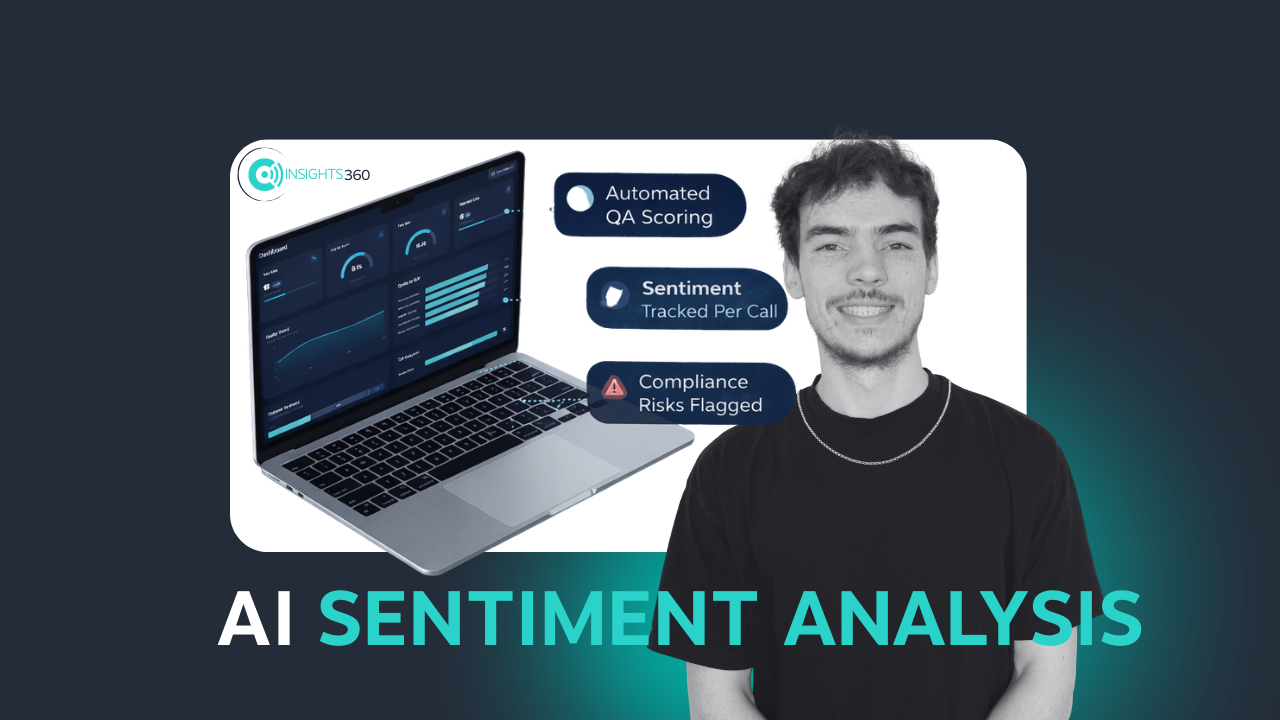
Sentiment analysis uses AI and natural language processing (NLP) to evaluate customer interactions—across voice, chat, and email—to determine emotional tone.
It identifies:
It identifies:
- Positive sentiment
- Neutral sentiment
- Negative sentiment
- Emotional shifts during the interaction
- Escalation points
Instead of relying solely on surveys, sentiment analysis evaluates 100% of conversations, giving you a far more accurate picture of agent performance.
Step 1: Define What “Good” Agent Performance Actually Means
Before you implement sentiment analysis, you must clearly define performance standards.
Ask yourself:
Ask yourself:
- What emotional outcome should customers leave with?
- How should agents handle frustrated or upset callers?
- What tone reflects your brand values?
- What behaviours signal empathy, ownership, and professionalism?
“Good” performance should include both operational outcomes and emotional outcomes.
For example:
For example:
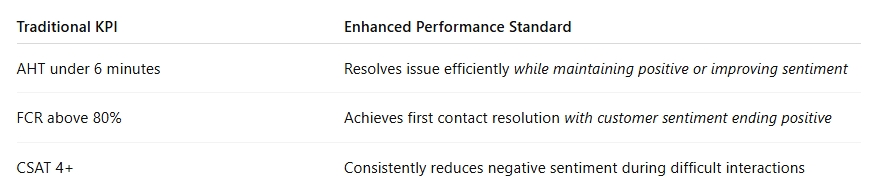
By defining “good” in emotional as well as operational terms, you create a clearer target for agents to aim at.
Step 2: Use Sentiment Benchmarks to Create Clear Standards
Once sentiment analysis is in place, you can establish measurable benchmarks such as:
- Target percentage of interactions ending in positive sentiment
- Reduction in negative sentiment across billing calls
- Improvement in sentiment recovery during escalations
- Agent-specific sentiment improvement over time
For example:
- 75% of calls should end in positive sentiment
- Negative sentiment should reduce by 30% during complaint calls
- Agents should demonstrate sentiment recovery in at least 60% of escalated conversations
These standards transform vague expectations like “be more empathetic” into measurable performance indicators.
Step 3: Identify Behavioural Patterns Behind High Sentiment Scores
Sentiment analysis doesn’t just measure emotion, it reveals patterns.
High-performing agents often:
High-performing agents often:
- Use empathetic language early in the call
- Avoid interrupting
- Take ownership of the issue
- Set clear expectations
- Offer proactive reassurance
By analysing conversations with strong sentiment outcomes, you can reverse-engineer best practices and turn them into coaching frameworks.
This creates a performance standard based on real behavioural evidence, not assumptions.
This creates a performance standard based on real behavioural evidence, not assumptions.
Step 4: Use Sentiment Data for Targeted Coaching
Traditional call sampling only reviews a small percentage of interactions. Sentiment analysis allows you to:
- Automatically flag calls with high negative sentiment
- Identify agents struggling with emotional de-escalation
- Spot improvement trends over time
- Deliver data-backed coaching
Instead of saying:
“You need to sound more empathetic.”
You can say:
“In 40% of complaint calls, customer sentiment remained negative. Let’s work on acknowledgement techniques in the first 60 seconds.”
Clear data leads to clearer coaching conversations.
“You need to sound more empathetic.”
You can say:
“In 40% of complaint calls, customer sentiment remained negative. Let’s work on acknowledgement techniques in the first 60 seconds.”
Clear data leads to clearer coaching conversations.
Step 5: Align Performance Standards with Business Outcomes
Improving customer sentiment isn’t just about “being nice.” It directly impacts:
- Customer retention
- Brand perception
- Complaint escalation rates
- Repeat contact rates
- Employee engagement
When you link agent sentiment performance to measurable business outcomes, performance standards become strategic rather than administrative.
For example:
For example:
- Positive sentiment correlates with higher renewal rates
- Reduced negative sentiment lowers complaint handling costs
- Agents with strong sentiment scores have lower attrition
This reinforces why defining and measuring “good” matters.
Common Mistakes to Avoid When Using Sentiment Analysis
To successfully set agent performance standards, avoid these pitfalls:
1. Using Sentiment as a Punitive Tool
Sentiment analysis should support coaching, not surveillance. Transparency is key.
2. Ignoring Context
A complaint call may start negative. The key metric is sentiment recovery, not perfection.
3. Focusing Only on Scores
Use sentiment insights to understand behaviours, not just rank agents.
4. Failing to Communicate Expectations
If agents don’t know what “good” looks like, sentiment scores won’t improve.
Remember: If you haven’t defined what “good” agent performance looks like, you can’t expect it to happen.
Remember: If you haven’t defined what “good” agent performance looks like, you can’t expect it to happen.
The Strategic Advantage of Sentiment-Driven Performance Standards
Organisations that integrate sentiment analysis into agent performance management gain:
- Clearer expectations
- More objective evaluations
- Better coaching outcomes
- Improved customer experience
- Stronger alignment between frontline teams and brand values
Instead of guessing what quality looks like, you measure it consistently and fairly.
Final Thoughts: Define It. Measure It. Improve It.
Agent performance management is evolving. Efficiency metrics alone no longer reflect the full customer experience.
By using sentiment analysis to define and measure emotional outcomes, you:
By using sentiment analysis to define and measure emotional outcomes, you:
- Clarify what “good” performance truly means
- Set measurable, data-backed standards
- Provide targeted coaching
- Improve both customer and business outcomes
Because ultimately:
If you haven’t defined what “good” agent performance looks like, you can’t expect it to happen.
If you haven’t defined what “good” agent performance looks like, you can’t expect it to happen.
Turn Insight into Action with Insights360
Defining clear agent performance standards is only possible when you have visibility into every interaction.
That’s where Insights360 makes the difference.
Insights360 uses advanced AI-powered sentiment analysis and conversation intelligence to analyse 100% of customer interactions across voice and digital channels. It helps contact centres:
That’s where Insights360 makes the difference.
Insights360 uses advanced AI-powered sentiment analysis and conversation intelligence to analyse 100% of customer interactions across voice and digital channels. It helps contact centres:
- Identify emotional trends in real time
- Track sentiment shifts during conversations
- Benchmark agent performance using measurable emotional outcomes
- Surface coaching opportunities automatically
- Align performance standards with real customer experience data
Instead of relying on small call samples or delayed surveys, Insights360 gives you a complete, data-driven view of what “good” agent performance truly looks like.
Whether you're looking to improve customer satisfaction, reduce complaints, increase retention, or create stronger coaching frameworks, Insights360 provides the clarity you need to define, measure, and continuously improve performance standards.
Because defining “good” shouldn’t be guesswork.
It should be measurable.
Whether you're looking to improve customer satisfaction, reduce complaints, increase retention, or create stronger coaching frameworks, Insights360 provides the clarity you need to define, measure, and continuously improve performance standards.
Because defining “good” shouldn’t be guesswork.
It should be measurable.
Ready to Set Clear Agent Performance Standards?
If you’re serious about improving customer experience and empowering your agents with clear, achievable standards, it’s time to move beyond traditional KPIs.
Discover how Insights360 can help you transform agent performance using sentiment analysis.
Book a demo today and see how data-driven performance management can elevate your contact centre.
Discover how Insights360 can help you transform agent performance using sentiment analysis.
Book a demo today and see how data-driven performance management can elevate your contact centre.